As Liane Rossler says, ‘Better an ounce of luck than a pound of gold’

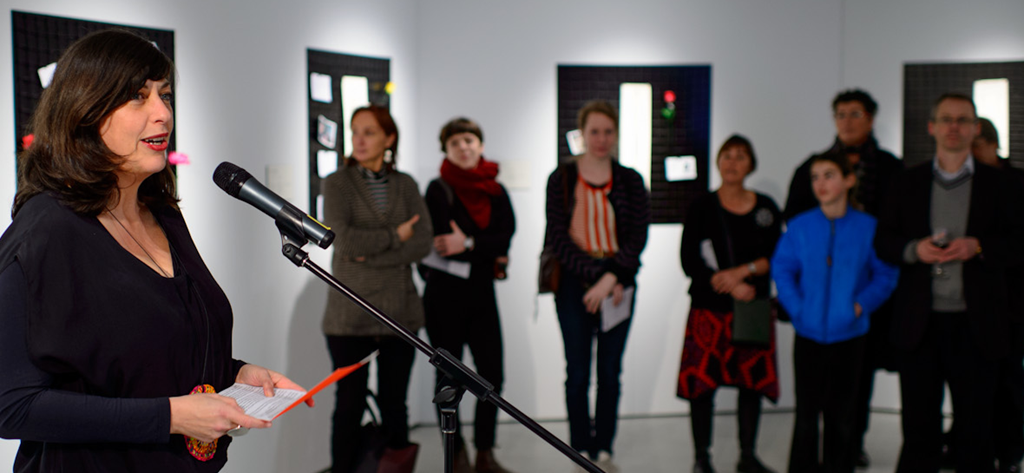
Liane Rossler opening Joyaviva in Sydney

Liane Rossler, ex-director of Dinosaur Designs and co-founder of Happy Talk kindly opened Joyaviva at UTS Gallery Sydney on the last night of July 2012.

Thank you for inviting me to open this very special exhibition.

Joyaviva means live jewellery, and it has been fascinating to walk around the show with Kevin and hear the stories about each piece. I love the quote ‘what can you pin your hopes on?’

Some of the pieces in the show might be very small, but they are still very powerful. They are a way to connect people. Each one was made with a deep intention, and they are designed with possibility and action in mind.

As a curator, Kevin has been connecting countries across the latitude from South America to the Pacific, and looked at all the ways that different cultures engage in traditions.

In each particular place, people have different needs of luck, different hopes and fears. From early times, we have created ways to share our fears and concerns with others. Often this was an amulet or talisman to protect us. Some concerns like love and good health are eternal, while others change and evolve. In the early days, people were concerned about the harvest or the afterlife, while these days we have concerns such as how we will do in our exams or how we’ll go in a job interview.

The value and the importance of the objects doesn’t come from the materials, such as gold and diamonds that we usually associate with valuable jewellery, but from the story, which in this case is more important. It relates to the Yiddish expression: ‘Better an ounce of luck than a pound of gold’. It makes us reconsider what is valuable.

This jewellery is quiet and personal, and is often worn unseen or under your clothing. It’s a quiet power, and one that might only be known to the wearer or the giver of the work.

Often the maker of the work is very thoughtful and contemplative when making the piece, and through the thoughts that they embody in the piece, they have the capacity to give somebody something when they really need it.

This exhibition shows objects just at their beginning. Many pieces are out in the world collecting stories. Some have been written about on the Luck bank, another part of the Joyaviva project, where people submit stories and then they can then get their luck back with interest. Luck is renewable, free, and available to all, but the best way to get good luck is to share good luck.

There are so many unique and interesting experiences covered in this exhibition, and I encourage you to read each one and then some of the follow up stories.

There is a beautiful fertility symbol made from a tactile river stone cut into two, where you put some cotton wool and a seed and in it, and it sprouts life.
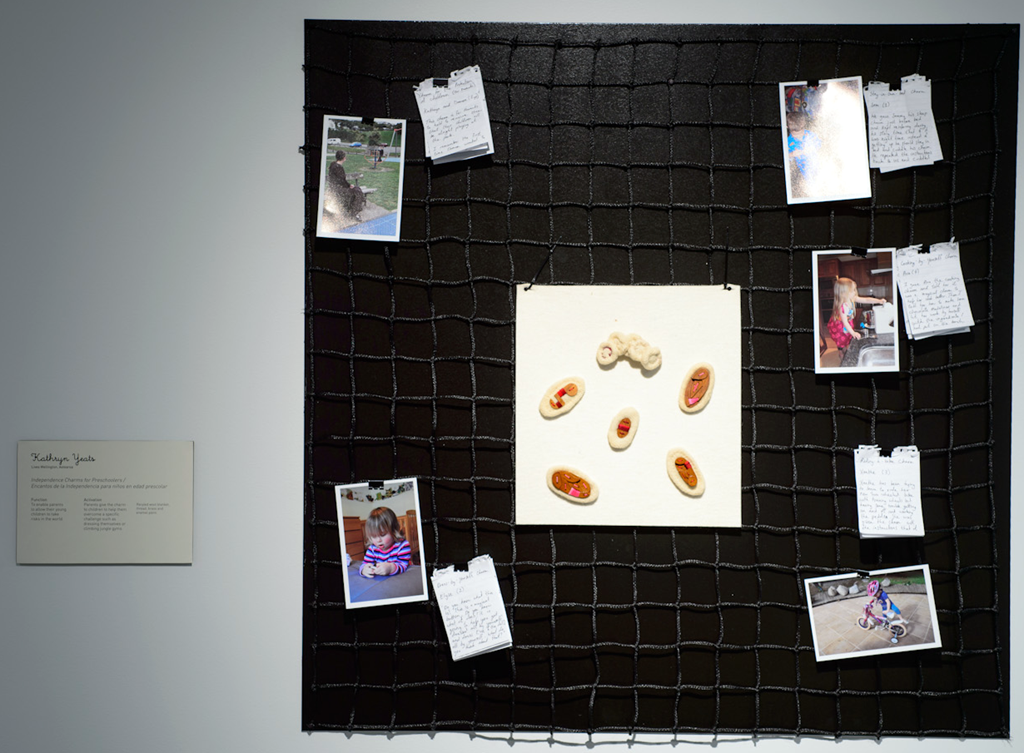
Katherine Yeats charms for pre-schoolersKatherine Yeats has made charms for preschoolers, which are made from blankets and wood and are designed to be held. They are given to young children when they have mastered a special task like getting dressed by themselves or learning to ride their bike. They’re a way of protection and encouragement and giving confidence.

I’m wearing my Maryann Talia Pau Power Sista pendant tonight, which were she designed to give to friends, and be worn when someone in the circle needs collective encouragement. Knowing you are in a network of friends gives you strength. I’m also thinking of Maryann tonight as she couldn’t be with us.

Alice Whish has made a series of sand, and each one has sand melted onto it that has been collected from the beach. They are designed to make children feel brave and calm when they are doing their Naplan tests.

Blanche Tilden piece – jewellery is traditionally about holding onto gold. She collected her filings over 15 years and made them into an ingot. You rub it with a little file to create a shower of gold.
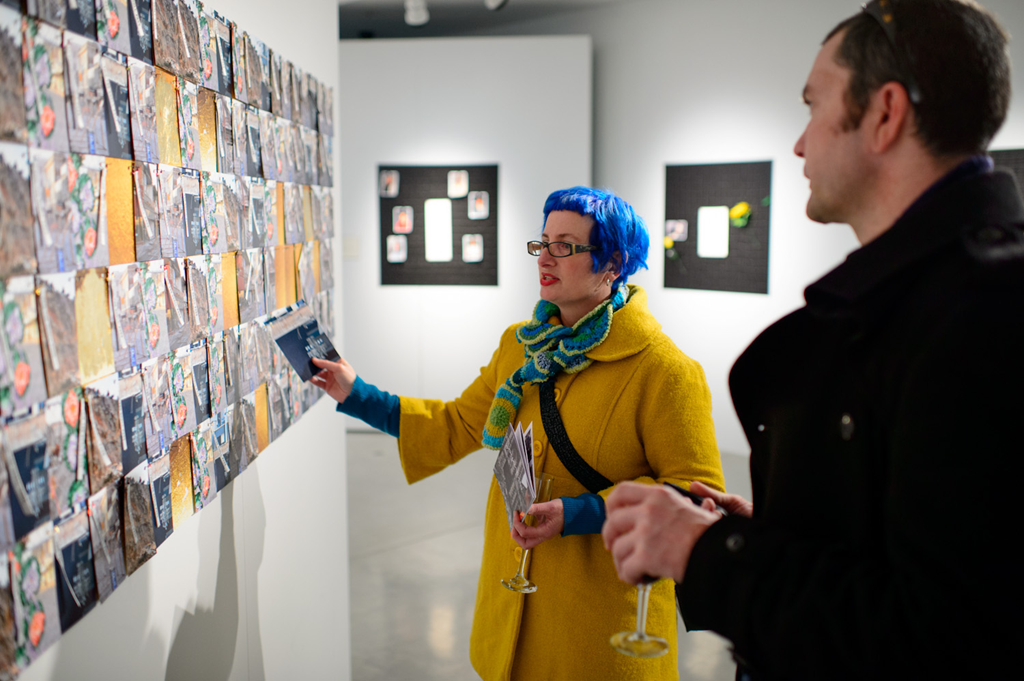
Looking at the Sarah Read installation and choosing a tagOn the wall – This too shall pass by Sarah Read from NZ. You buy a piece for $10 and when you remove the card, it reveals a gold wall, so as well as spreading good thoughts that bad things will pass, Sarah aims to create a gold wall. Make sure you buy one..

Walka Studio from Chile have made a Cornucopia piece which is about social and sharing environments. They create great nights, and then people take away a piece to remember and cherish the occasion of good times.

So thank you all from coming. I congratulate Kevin, the artists and everyone involved in this project.

I hope you take away something tonight, even if it is only a thought, that will be a happy memory from this exhibition.
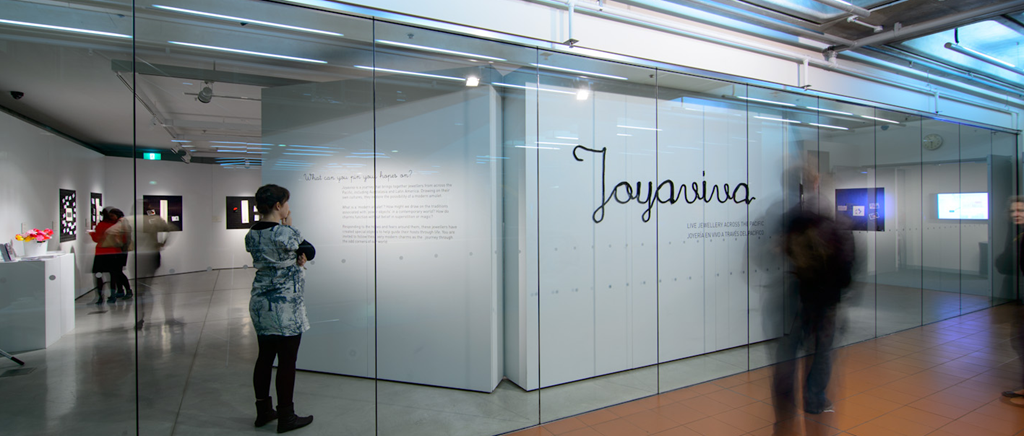
Joyaviva in Sydney

Joyaviva continues in Sydney until the end of August 2012.

Joyaviva opens in Sydney 31 July

OPENING TUESDAY 31 JULY 6-8PM

JOYAVIVA
LIVE JEWELLERY FROM ACROSS THE PACIFIC 
31 July – 31 August 2012

Curated by Kevin Murray, Joyaviva: Live Jewellery from across the Pacific is an exhibition of beautiful, potent objects that recover the power of jewellery in our world.
 
Made by a new wave of jewellers from Australia, New Zealand and Chile, each of the pieces on display is ‘alive’ as a device for sharing hopes and responding to our fears – ranging from threat of earthquakes to success in a school exam. Created from diverse materials, these objects link people together – transforming private wishes into shared stories.

Melissa Cameron, Jill Hermans, Caz Guiney, Maryann Talia Pau, Jin ah Jo, Blanche Tilden, Alice Whish (Australia)
Jacqui Chan, Ilse-Marie Erl, Sarah Read, Gina Ropiha, Areta Wilkinson, Matthew Wilson, Katheryn Yeats (Aotearoa / New Zealand)
Guillermina Atunez, Francisco Ceppi, Analya Cespedes, Carolina Hornauer, Massiel Mariel, Angela Cura Mendes, Valentina Rosenthal, WALKA STUDIO (Chile)

Visit www.joyaviva.net to learn more about the objects, their creators and hosts.

UTS GALLERY
Level 4, Peter Johnson Building, 702 Harris Street, Ultimo, NSW, Australia
Open Monday – Friday 12-6pm

www.utsgallery.uts.edu.au

IMAGE:  Jacqui Chan Brooch from Host A Brooch in action, 2011, cable, silver


Joyaviva: Live Jewellery from across the Pacific was shown at RMIT in Feb 2012. It will be touring to Objectspace Auckland (NZ), Santiago and Valparaiso (Chile), Jalsuri Foundation (Bolivia) and Mexico City, Mexico
Joyaviva is a project associated with the Ethical Design Laboratory, a research area of RMIT Centre for Design. Supported by the Council on Australia Latin America Relations and Creative NZ

UTS Gallery supported by Oyster Bay Wines and Coopers. Media Partner: 2ser

Missing in Action: Felicity Powell’s Charmed Life in London

Felicity Powell: Charmed Life – The Solace of Objects

Wellcome Collection, London

5 October 2011 – 26 February 2012

Felicity Powell: Charmed Life exhibition. Amulet from the Lovett Collection © Pitt Rivers Museum, University of Oxford., reproduced courtesy of Wellcome Collection, London

Charmed Life is the result of an artist, Felicity Powell, coming into contact with a collection of charms, now in the Pitt Rivers Museum in Oxford, which was created by Edward Lovett in the early twentieth century. According to the introductory wall text:

One of the few people to have had access to this curious collection of “charms”, once carried in the pockets of Londoners for luck or protection, Powell was intrigued by the silent witness they bore to countless personal narratives, most of which are now lost to history. Despite being long divorced from their original owners, these objects seemed to retain an insistent sense that they might yet hold some hidden magic.

The exhibition is divided between the presentation of Lowell’s collection (in cases installed in the gallery walls, and most spectacularly in a horseshoe-shaped vitrine) and Powell’s delicate wax reliefs, which are hung along the gallery walls. A smaller gallery houses two specially made video works that document and expand Powell’s practice.

The charms are great. Those which have been selected for display in the wall cases attract by their strangeness and sometimes weird skill: George Yeofound’s Lord’s Prayer, written in tiny letters on a saw-tooth edged piece of paper, and carried as an amulet by a soldier in the Middlesex regiment in 1917 (no-one knows if it worked); a piece of folded bark with text in Karoshti, a language from Central Asia, perhaps written in the seventh century, but which can’t be unrolled to read as it is too fragile; brass rings from Syria, to be worn by men on the thumb as protection against sore eyes; blue glass beads worn by children in London in the early twentieth century, as a protection against bronchitis; or my personal favourite, a coil of wire, of a ‘length equal to height of person’ (as it says on the card), ensuring the successful resolution of any request by the person who possesses it.

It’s a mix of factors that creates the magic of these charms: the nature of the objects themselves, in some cases; or the belief systems that they represent, and to which we are both divorced and sympathetic; or the way a specific charm was worn or interacts with the body. (This is what I love about the coil of wire. It feels like contemporary jewellery in terms of the way it relates to the body – a strange but somehow entirely appropriate and meaningful equivalence.)

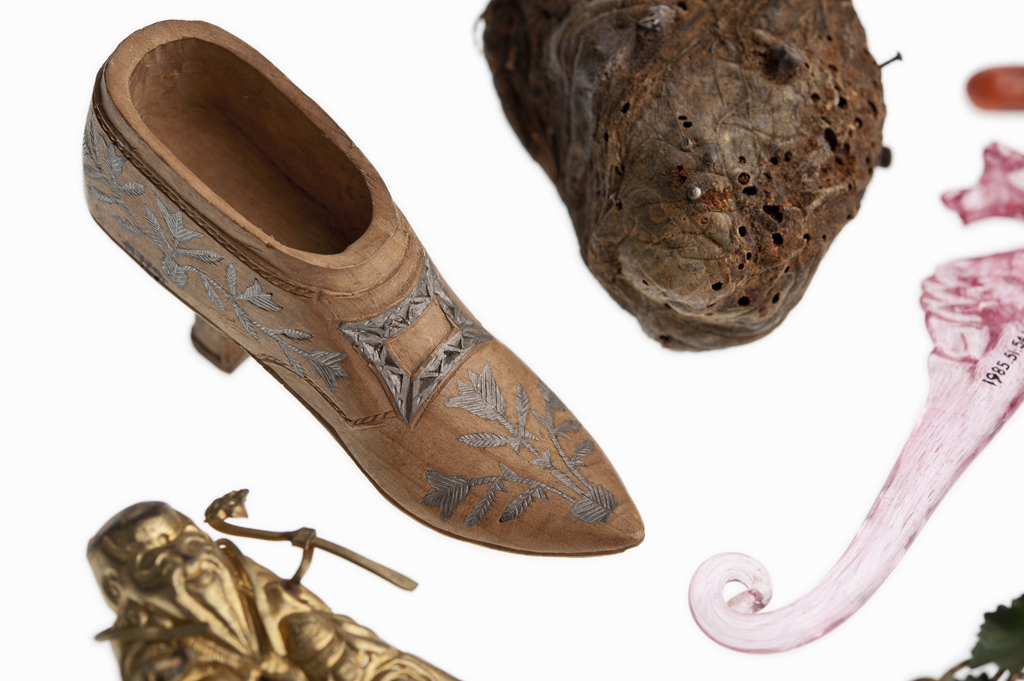
The horseshoe table (in person not at all an overdone visual pun) is also a delight. Various objects, an intriguing mix of powerful and pathetic, are placed on a white glowing surface, lit from underneath, and arranged in a series of flowing lines and clusters, that intimate power or connection, as if these objects have somehow been arranged – arranged themselves? – according to sympathetic magics. It is delicately done – in one section, coral and sea creatures in bone and shell, plus teeth, give way to glass seahorses and abstract glass amulets, which then turn into glass and bone and wooden miniature shoes. While it might be spurious, it is a nice display device for reanimating these objects, suggesting the agency that they once had.

Felicity Powell: Charmed Life exhibition. Amulet from the Lovett Collection © Pitt Rivers Museum, University of Oxford, reproduced courtesy of Wellcome Trust

This hint of animating forces raises the major criticism I have of this exhibition: the missing factor of agency, and the relative lack of any attempt to animate these charms, to activate them. That they once had power is definitely acknowledged: the introductory wall text, for example, says that ‘Each has been invested with the hope or belief that it could somehow mediate on behalf of its owner. They are tiny embodiments of the anxieties we feel about our human frailties, their assumed powers often drawing on the dark arts of superstition and magic.’ And a text about the table of charms notes that ‘Edward Lovett’s collection of amulets offers an insight into the lives, hopes and beliefs of people from the poorest parts of early 20th-century London. . . . Here the religious merges with the secular while ancient belief systems combine with folklore and the fear of witchcraft.’

But these objects are now understood to be drained of power. In a kind of academic bloodlessness, they are presented as evidence of history and sociology, a way to understand and access the past. I wonder what this exhibition would be like if the charms were understood as still powerful, and the project worked to animate them, or deal with how they operate as mediations between the wearer and the larger forces that govern life? And would an exhibition like this require or suggest a different approach in a different social context – like Aotearoa New Zealand, for example, where it isn’t any great stretch to believe in, and acknowledge, the agency of objects?

Powell has a definite and obvious sympathy for these objects, but it is, as her own work demonstrates, to do with the charms as inspiration for now-silenced and strange narratives and beliefs. Her wax reliefs are very intriguing and they are even created on the back of circular mirrors, suggesting activation, the body, use through wearing (even if it is reflected wearing). And yet this is not the point of the work – the reflective surface is turned away from the viewer, who looks at the back of the mirror, not the front. Powell takes inspiration from the forms of the charms, creating scenes in which objects and people behave in strange ways, as if manifesting the mindset that could also craft and wear charms to address their needs. This is entirely about Powell’s practice, and her symbolic visual language, that in all its codes and conventions is ultimately totally divorced from the charms and those who used them as objects of power.

I don’t mean to suggest that this represents a failure in this exhibition, or in Powell’s art. In its own terms, this is a great show, and a beautiful body of work that repays close viewing. But, from the perspective of charms – or live jewellery – or even contemporary jewellery – these objects are not allowed to be alive in this project. Ultimately I wonder what a jeweller might have made of this opportunity, and what kind of encounter they might have had with Lovett’s collection.

In a wall text about Lovett, the following statement occurs: ‘Although he was himself dismissive of the idea that amulets could work as effective magical objects, he did, poignantly, make his younger son an amulet to wear against the dangers of the front during World War I.’ Ambivalence of this sort is both rejection and desire, and ī would argue that this exhibition mines – and suffers from – precisely this condition. As a framework, it unlocks these objects, but doesn’t exhaust them – or ultimately set them free.

Damian Skinner is the editor of Art Jewelry Forum and currently completing a fellowship at Cambridge University