Felicity Powell: Charmed Life – The Solace of Objects
Wellcome Collection, London
5 October 2011 – 26 February 2012

Charmed Life is the result of an artist, Felicity Powell, coming into contact with a collection of charms, now in the Pitt Rivers Museum in Oxford, which was created by Edward Lovett in the early twentieth century. According to the introductory wall text:
One of the few people to have had access to this curious collection of “charms”, once carried in the pockets of Londoners for luck or protection, Powell was intrigued by the silent witness they bore to countless personal narratives, most of which are now lost to history. Despite being long divorced from their original owners, these objects seemed to retain an insistent sense that they might yet hold some hidden magic.
The exhibition is divided between the presentation of Lowell’s collection (in cases installed in the gallery walls, and most spectacularly in a horseshoe-shaped vitrine) and Powell’s delicate wax reliefs, which are hung along the gallery walls. A smaller gallery houses two specially made video works that document and expand Powell’s practice.
The charms are great. Those which have been selected for display in the wall cases attract by their strangeness and sometimes weird skill: George Yeofound’s Lord’s Prayer, written in tiny letters on a saw-tooth edged piece of paper, and carried as an amulet by a soldier in the Middlesex regiment in 1917 (no-one knows if it worked); a piece of folded bark with text in Karoshti, a language from Central Asia, perhaps written in the seventh century, but which can’t be unrolled to read as it is too fragile; brass rings from Syria, to be worn by men on the thumb as protection against sore eyes; blue glass beads worn by children in London in the early twentieth century, as a protection against bronchitis; or my personal favourite, a coil of wire, of a ‘length equal to height of person’ (as it says on the card), ensuring the successful resolution of any request by the person who possesses it.
It’s a mix of factors that creates the magic of these charms: the nature of the objects themselves, in some cases; or the belief systems that they represent, and to which we are both divorced and sympathetic; or the way a specific charm was worn or interacts with the body. (This is what I love about the coil of wire. It feels like contemporary jewellery in terms of the way it relates to the body – a strange but somehow entirely appropriate and meaningful equivalence.)
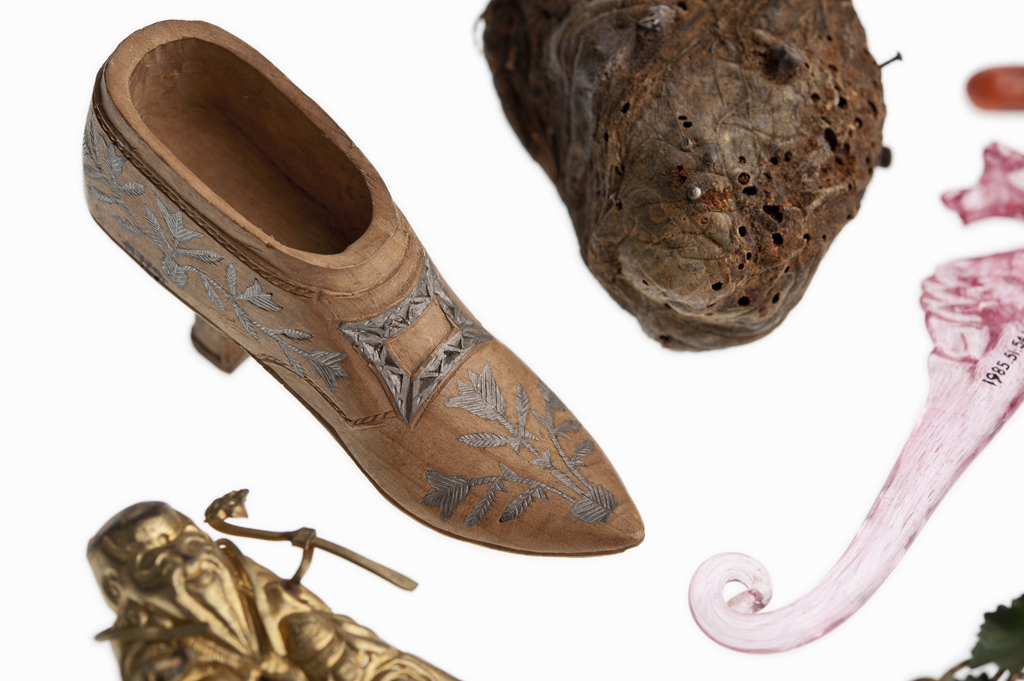
The horseshoe table (in person not at all an overdone visual pun) is also a delight. Various objects, an intriguing mix of powerful and pathetic, are placed on a white glowing surface, lit from underneath, and arranged in a series of flowing lines and clusters, that intimate power or connection, as if these objects have somehow been arranged – arranged themselves? – according to sympathetic magics. It is delicately done – in one section, coral and sea creatures in bone and shell, plus teeth, give way to glass seahorses and abstract glass amulets, which then turn into glass and bone and wooden miniature shoes. While it might be spurious, it is a nice display device for reanimating these objects, suggesting the agency that they once had.
This hint of animating forces raises the major criticism I have of this exhibition: the missing factor of agency, and the relative lack of any attempt to animate these charms, to activate them. That they once had power is definitely acknowledged: the introductory wall text, for example, says that ‘Each has been invested with the hope or belief that it could somehow mediate on behalf of its owner. They are tiny embodiments of the anxieties we feel about our human frailties, their assumed powers often drawing on the dark arts of superstition and magic.’ And a text about the table of charms notes that ‘Edward Lovett’s collection of amulets offers an insight into the lives, hopes and beliefs of people from the poorest parts of early 20th-century London. . . . Here the religious merges with the secular while ancient belief systems combine with folklore and the fear of witchcraft.’
But these objects are now understood to be drained of power. In a kind of academic bloodlessness, they are presented as evidence of history and sociology, a way to understand and access the past. I wonder what this exhibition would be like if the charms were understood as still powerful, and the project worked to animate them, or deal with how they operate as mediations between the wearer and the larger forces that govern life? And would an exhibition like this require or suggest a different approach in a different social context – like Aotearoa New Zealand, for example, where it isn’t any great stretch to believe in, and acknowledge, the agency of objects?
Powell has a definite and obvious sympathy for these objects, but it is, as her own work demonstrates, to do with the charms as inspiration for now-silenced and strange narratives and beliefs. Her wax reliefs are very intriguing and they are even created on the back of circular mirrors, suggesting activation, the body, use through wearing (even if it is reflected wearing). And yet this is not the point of the work – the reflective surface is turned away from the viewer, who looks at the back of the mirror, not the front. Powell takes inspiration from the forms of the charms, creating scenes in which objects and people behave in strange ways, as if manifesting the mindset that could also craft and wear charms to address their needs. This is entirely about Powell’s practice, and her symbolic visual language, that in all its codes and conventions is ultimately totally divorced from the charms and those who used them as objects of power.
I don’t mean to suggest that this represents a failure in this exhibition, or in Powell’s art. In its own terms, this is a great show, and a beautiful body of work that repays close viewing. But, from the perspective of charms – or live jewellery – or even contemporary jewellery – these objects are not allowed to be alive in this project. Ultimately I wonder what a jeweller might have made of this opportunity, and what kind of encounter they might have had with Lovett’s collection.
In a wall text about Lovett, the following statement occurs: ‘Although he was himself dismissive of the idea that amulets could work as effective magical objects, he did, poignantly, make his younger son an amulet to wear against the dangers of the front during World War I.’ Ambivalence of this sort is both rejection and desire, and ī would argue that this exhibition mines – and suffers from – precisely this condition. As a framework, it unlocks these objects, but doesn’t exhaust them – or ultimately set them free.
Damian Skinner is the editor of Art Jewelry Forum and currently completing a fellowship at Cambridge University
 Luck by design: Artists speak about their work in the Joyaviva exhibition